
YukiDobo
Happy life with lovely cats and husband
Origami is the art of paper-folding. Its name derives from Japanese words ori (“folding”) and kami (“paper”). Traditional origami consists of folding a single sheet of square paper (often with a colored side) into a sculpture without cutting, gluing, taping, or even marking it.
Today in Japan the art of paper-folding is as widely practiced by children, parents and grandparents as it was centuries ago. And for a number of years now origami has been immensely popular here in the western world.
I enjoy making Origami art. Please check my origami art!
Origami


Japanese calligraphy (書道 shodō) also called shūji (習字) is a form of calligraphy, or artistic writing, of the Japanese language.
These days, most Japanese use pencils, ballpoints, or felt-tip pens to write letters and other documents. But the art of shodo (calligraphy), where an ink-dipped brush is used artistically to create Chinese kanji and Japanese kana characters, remains a traditional part of Japan's culture. Works of calligraphy are admired for the accurate composition of their characters, of course, but also for the way the brush is handled in their creation, the shading of the ink, and the balanced placement of the characters on the paper.
Different types of calligraphy include kaisho, or "square style," where the strokes in the characters are precisely drawn in a printed manner; gyosho, or "semicursive," which is written faster and more loosely; and sosho, or "cursive," a much freer, more fluid method where the characters' strokes can bend and curve.
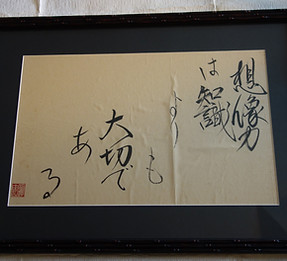
Calligraphy
Kimono
Originally, "kimono" was the Japanese word for clothing. Kimonos as we know them today came into being during the Heian period (794-1192).
We changed kimono type from Informal occasion to formal occasion.
Komon --> Tsukesage --> Furisode --> Tomesode
Nowadays, Japanese people rarely wear kimonos in everyday life, reserving them for such occasions as shichi-go-san (“seven-five-three”), coming-of-age day, collage graduation, weddings, funerals, tea ceremonies, or other special events, such as summer festivals.
This is my shichi-go-san picture when I was seven years old. My grandmother prepared this furisode for me.

Kamakura bori
Kamakura-bori is a type of lacquer ware made in the area around the city of Kamakura in Kanagawa prefecture. The tradition dates back to the Kamakura period when Tsuishu and Tsuikoku, thickly lacquered wooden wares, were imported from China alongside other artistic crafts. The style of the imported wares was later incorporated with Japanese arts and traditional patterns and Kamakura-bori was born. Initially, Kamakura-bori techniques were mainly applied to Buddhist statues and altar items. Under the influence of Chinese handicraft work, sculptors of Buddhist ritual implements and temple carpenters started to carve Japanese Judas tree or ginkgo into wooden wares and applied a lacquer finish to pieces that were given the name Kamakura-bori. Today, production has spread to include everyday goods like inkstone cases, paperweights, plates, and trays.
Kamakura-bori features chisel markings left intentionally to accentuate patterned areas. Another unique technique is to sprinkle black powder on a vermilion lacquered surface, in order for the patterns to stand out from the darkened background. The carving and lacquering techniques of Kamakura-bori have evolved for the past 800 years. Even today, Kamakura constantly attracts visitors looking for that perfect lacquer ware that will add enhancement to daily life.
